
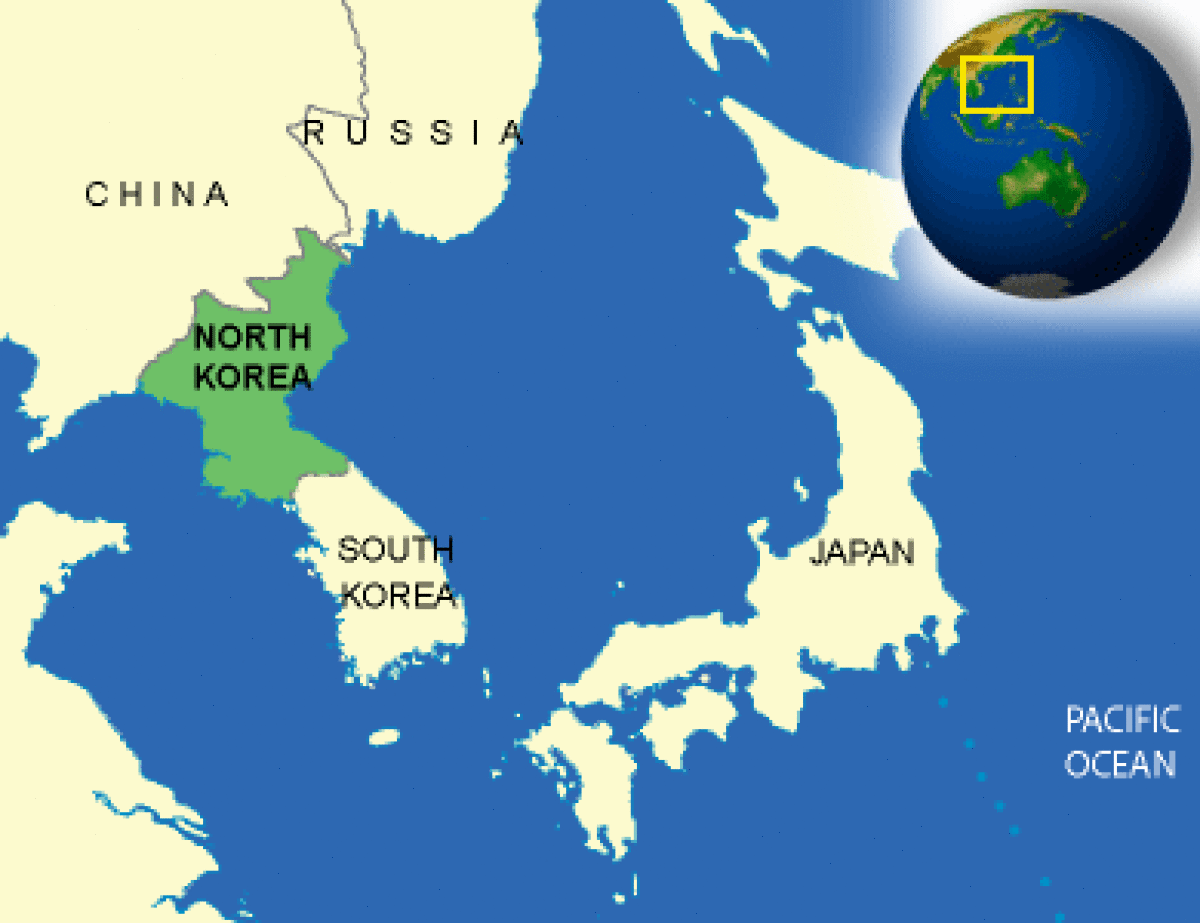
Where is Korea, North?
What countries border Korea, North?
Korea, North Weather
What is the current weather in Korea, North?
Korea, North Facts and Culture
What is Korea, North famous for?
- Cultural Attributes: One should be aware of the pervasive influence of self reliance on the Korean psyche. It impacts every aspect Korean... More
- Family: The family remains an important part of Korean life. The population has been constantly exhorted by the government to “love... More
- Personal Appearance: For special occasions or holidays traditional clothing is often worn. Women frequently wear the "hanbok", a two-piece, long colorful dress... More
- Recreation: Koreans enjoy traditional sports like tae-kwon-do, a form of martial arts that originated in Korea 2000 years ago as an... More
- Diet: Spicy pickled cabbage (called Kimch'i) and rice are the mainstays of the diet around which most other dishes revolve. Meals... More
- Food and Recipes: Families rarely have time to eat daily meals together. Fathers often leave early in the morning and return late at... More
- Visiting: Koreans do not commonly visit one another unannounced, and arranged social visits are infrequent. Generally, people visit relatives for the... More
- Dating: The government has established minimum marriage ages (27 for men, 25 for women) to allow for the completion of military... More

Korea, North Facts
What is the capital of Korea, North?
| Capital | Pyongyang |
| Government Type | dictatorship, single-party state; official state ideology of "Juche" or "national self-reliance" |
| Currency | North Korean Won (KPW) |
| Total Area |
46,540 Square Miles 120,538 Square Kilometers |
| Location | Eastern Asia, northern half of the Korean Peninsula bordering the Korea Bay and the Sea of Japan, between China and South Korea |
| Language | Korean |
| GDP - real growth rate | 1% |
| GDP - per capita (PPP) | $1,800.00 (USD) |
Korea, North Demographics
What is the population of Korea, North?
| Ethnic Groups | racially homogeneous; there is a small Chinese community and a few ethnic Japanese |
| Languages |
Korean is spoken in both North and South Korea and is written in a phonetic alphabet created and promulgated in the mid-15th century. While the alphabet is called Hangul in South Korea, it is known as Chosongul in North Korea. Although the Korean language is derived with words adapted from Chinese, the North Koreans, unlike the South Koreans, do not use Chinese characters with Chosongul in their newspapers and publications. They prefer to use only Chosongul, which is sufficient for most needs. There are differences in vocabulary between the North and the South, influenced somewhat by politics and also by the contact each country has had with other nations. Russian, Chinese, and English are taught as second languages in the schools. |
| Nationality Noun | Korean(s) |
| Population | 25,643,466 |
| Population Growth Rate | 0.53% |
| Population in Major Urban Areas | PYONGYANG (capital) 2.843 million |
| Urban Population | 60.300000 |
Korea, North Government
What type of government does Korea, North have?
| Suffrage | 17 years of age; universal and compulsory |
| Citizenship |
citizenship by birth: no citizenship by descent only: at least one parent must be a citizen of North Korea dual citizenship recognized: no residency requirement for naturalization: unknown |
| National Holiday | Founding of the Democratic People's Republic of Korea (DPRK), 9 September (1948) |
| Constitution |
history: previous 1948, 1972; latest adopted 1998 (during KIM Jong-il era) amendments: proposed by the Supreme People’s Assembly (SPA); passage requires more than two-thirds majority vote of the total SPA membership; revised several times, last in 2023 |
| Independence | 15 August 1945 (from Japan) |
Korea, North Video
YouTube: Unesco Taekkyeon, a traditional Korean martial art
CountryReports YouTube Channel:
Join CountryReports YouTube Channel (Click Here)Korea, North Geography
What environmental issues does Korea, North have?
| Climate | temperate with rainfall concentrated in summer |
| Border Countries | China 1,416 km, South Korea 238 km, Russia 19 km |
| Environment - Current Issues | water pollution; inadequate supplies of potable water; water-borne disease; deforestation; soil erosion and degradation |
| Environment - International Agreements | party to: Antarctic Treaty, Biodiversity, Climate Change, Climate Change-Kyoto Protocol, Desertification, Environmental Modification, Hazardous Wastes, Ozone Layer Protection, Ship Pollution signed, but not ratified: Law of the Sea |
| Terrain | mostly hills and mountains separated by deep, narrow valleys; coastal plains wide in west, discontinuous in east |
Korea, North Economy
How big is the Korea, North economy?
| Economic Overview |
The economy of North Korea operates as a centrally planned and autarkic system, heavily influenced by the ideological principles of Juche (self-reliance) and state socialism. Its structure is characterized by state ownership of production, centralized decision-making, and limited integration with the global economy. This overview examines the key aspects of the North Korean economy, including its historical development, current composition, external relations, and challenges. 1. Historical Context The foundation of North Korea's economic system was laid after its establishment in 1948, under the leadership of Kim Il-sung. The economy initially benefited from Soviet aid and technical assistance, along with access to industrial resources left by Japan after World War II. During the 1950s and 1960s, North Korea experienced rapid industrialization, particularly in heavy industries such as steel, chemicals, and machinery. However, the economy began to stagnate in the 1970s due to inefficiencies in central planning, declining external support, and an overemphasis on militarization. 2. Economic Composition North Korea's economy is divided into several key sectors: Agriculture: The agricultural sector operates under a system of collectivized farming. The country faces chronic food shortages due to a lack of arable land, outdated technology, and climate challenges. Key crops include rice, corn, and potatoes. Industry: Heavy industry, such as mining and metallurgy, remains a priority. The country possesses significant reserves of coal, iron ore, and rare earth minerals, which form the backbone of its export economy. Services: The service sector is underdeveloped, with limited commercial activity outside state-controlled enterprises. Black markets, often referred to as the "jangmadang," play an increasing role in informal economic exchanges. 3. Trade and International Relations North Korea's foreign trade is highly constrained by international sanctions imposed due to its nuclear weapons program. The country relies heavily on trade with China, which accounts for approximately 90% of its imports and exports. Primary exports include coal, textiles, and labor services, while imports consist of fuel, machinery, and food. 4. Challenges and Vulnerabilities The North Korean economy faces significant structural and external challenges: Sanctions: Multilateral and unilateral sanctions have restricted North Korea's access to international markets and financial systems, severely impacting its ability to sustain economic growth. Resource Dependence: Over-reliance on China for trade and limited diversification in exports make the economy vulnerable to external shocks. Food Security: Chronic food shortages and undernourishment remain pressing issues, exacerbated by climatic conditions and inefficiencies in agricultural production. Technological Stagnation: The lack of access to modern technology and infrastructure hampers productivity across all sectors. Militarization: A disproportionate allocation of resources to military and defense sectors detracts from potential investments in social and economic development. 5. Recent Developments and Prospects In recent years, North Korea has shown sporadic interest in limited market reforms and engagement with foreign investors, though these efforts remain tightly controlled and have yet to result in significant economic liberalization. The COVID-19 pandemic has further isolated the country, disrupting trade and exacerbating its economic challenges. |
| Industries | military products; machine building, electric power, chemicals; mining (coal, iron ore, magnesite, graphite, copper, zinc, lead, and precious metals), metallurgy; textiles, food processing; tourism |
| Currency Name and Code | North Korean Won (KPW) |
| Export Partners | South Korea 28.5%, China 28.4%, Japan 24.7% |
| Import Partners | China 39.7%, Thailand 14.6%, Japan 11.2%, Germany 7.6%, South Korea 6.2% |
Korea, North News and Current Events
What current events are happening in Korea, North?
Source: Google News
Korea, North Travel Information
What makes Korea, North a unique country to travel to?
Country Description
The Democratic People’s Republic of Korea (North Korea or the DPRK) is a highly regimented, repressive Communist state located on the Korean Peninsula between northeast China and the Republic of Korea (South Korea or the ROK), sharing land borders with China, Russia, and South Korea. The border between North and South Korea is closed. The United States does not maintain diplomatic or consular relations with North Korea. The Embassy of Sweden in Pyongyang acts as the United States’ interim protecting power and provides basic consular services to U.S. citizens traveling in North Korea. For additional information, please refer to the section on “Special Circumstances” below.
Crime
North Korea does not release crime statistics. Violent crime is rare, and street crime against foreigners is uncommon in Pyongyang. Petty thefts have been reported, especially at the airport in Pyongyang.Do not buy counterfeit and/or pirated goods, even if they are widely available. The purchase of counterfeit and pirated goods is illegal in the United States and may be illegal in North Korea.
Criminal Penalties
The North Korean system does not operate according to the rule of law, and foreigners should harbor no expectations regarding due process. Foreign visitors to North Korea may be arrested, detained, or expelled for activities that would not be considered criminal outside North Korea, including involvement in unsanctioned religious and/or political activities (whether those activities took place inside or outside North Korea), unauthorized travel, or unauthorized interaction with the local population. If you do something considered illegal in North Korea, you may be subject to the North Korean judicial system, which is an instrument of state power and not an independent branch of government. Protections guaranteed under the U.S. legal system do not apply, and possession of a U.S. passport does not confer special status. Your local host/liaison may be able to provide useful guidance.North Korean security personnel may regard as espionage unauthorized or unescorted travel inside North Korea and unauthorized attempts to speak directly with North Korean citizens. North Korean authorities may fine or arrest you for exchanging currency with an unauthorized vendor, for taking unauthorized photographs, or for shopping at stores not designated for foreigners. It is a criminal act in North Korea to show disrespect to the country's current and former leaders – Kim Jong Un, Kim Jong Il, and Kim Il Sung. A near-religious cult surrounds treatment of these individuals, and acts that would be deemed unexceptional elsewhere in the world – e.g., placing in the garbage newspapers bearing their photographs – may be deemed disrespectful.
Although North Korea has granted press visas for cultural or sporting events or visits of foreign leaders, officials watch closely to prevent journalists from talking to ordinary people or questioning the policies, actions, or public statements of North Korea’s leadership. North Korea has confiscated objectionable material from foreign journalists. Journalists who engaged in activities that challenged the regime have been deported, arrested, or detained to face criminal charges.
North Korean government security personnel closely monitor the activities and conversations of foreigners in North Korea. Never bring or handle any material, printed or digital, that could be interpreted as critical of, or hostile to, the country or its leadership. Hotel rooms, telephones, and fax machines may be monitored, and personal possessions in hotel rooms may be searched. Do not take pictures without explicit authorization. North Korean government authorities may view taking unauthorized pictures as espionage, confiscate cameras and film and/or detain the photographer. Persons violating the laws of North Korea, even unknowingly, may be expelled, arrested, or imprisoned.
Engaging in sexual conduct with minors or using or disseminating child pornography in a foreign country is a crime, prosecutable in the United States.
Languages
Korean is spoken in both North and South Korea and is written in a phonetic alphabet created and promulgated in the mid-15th century. While the alphabet is called Hangul in South Korea, it is known as Chosongul in North Korea. Although the Korean language is derived with words adapted from Chinese, the North Koreans, unlike the South Koreans, do not use Chinese characters with Chosongul in their newspapers and publications. They prefer to use only Chosongul, which is sufficient for most needs.There are differences in vocabulary between the North and the South, influenced somewhat by politics and also by the contact each country has had with other nations. Russian, Chinese, and English are taught as second languages in the schools.
Medical Facilities and Health Information
If you have medical problems, you should not travel to North Korea. For decades, medical facilities in the DPRK have suffered from a lack of resources and electricity. Medical personnel often have inadequate or outdated skills. Hospitals in Pyongyang can perform basic examinations and lifesaving measures, but functioning x-ray facilities are not generally available. If possible, avoid surgery. If you have an accident outside Pyongyang, transport back to the capital can be lengthy and without medical assistance. According to DPRK Customs, most prescription medication may be brought into the country with no restrictions. If you require regular medication, you should bring a sufficient amount for your personal use along with the doctor’s prescription, since most drugs are unavailable locally. Hospitals will expect immediate U.S. dollar cash payment for medical treatment. You cannot use credit cards or checks in the DPRK. Local DPRK hosts are often not aware of options available for medical evacuations and might claim that no such options exist. It is important to insist on immediate contact with the Embassy of Sweden if you have serious medical problems.Tuberculosis is an increasingly serious health concern in North Korea.
Medical Evacuations: In the case of a critical illness or accident, immediately contact the Embassy of Sweden, which will attempt to arrange flight clearances for air ambulances performing emergency medical evacuations. Costs for medical air evacuation vary, but according to SOS International, an evacuation from Pyongyang to Beijing averages approximately USD 40,000 including medical personnel (1 doctor and 1 nurse), the aircraft, and clearance costs. The General Bureau of the Koryo Civil Aviation of the DPRK says that it provides around-the-clock service and that requests for air clearance will be granted within 24 hours. If a U.S. citizen with a medical emergency is in Pyongyang, the Embassy of Sweden can usually arrange a medical evacuation to Beijing in one day. If the patient is located outside Pyongyang, it will take longer. Medical evacuation by regularly scheduled airlines can be arranged, but very few flights operate from Pyongyang to Beijing (Air Koryo and Air China), Shenyang (Air Koryo), or Vladivostok (Air Koryo). Air Koryo flights go to Shanghai only on a charter basis in the tourist season (April-October). In order to transit China, Chinese visas for injured foreigners and any escorts must be obtained prior to the evacuation from North Korea. Even in the case of a medical emergency, transit visas may take several days to arrange. Evacuation across the DMZ to South Korea is not allowed.
Vaccinations: You should get all necessary vaccinations prior to traveling to North Korea. You can find information on vaccinations and other health precautions, such as safe food and water precautions and insect bite protection, at the Centers for Disease Control and Prevention’s hotline for international travelers at 1-877-FYI-TRIP (1-877-394-8747) or via the CDC Internet site. For information about outbreaks of infectious diseases abroad consult the World Health Organization's (WHO) website. If you have special dietary requirements, you are advised to bring food with you to North Korea, as the restaurants available to foreigners have limited menus that lack variety and nutritional adequacy.
Companies that may be able to arrange evacuation services include, but are not limited to, those listed below. You may wish to contact these or other emergency medical assistance providers for information about their ability to provide medical evacuation insurance and/or assistance for travelers to North Korea.
International SOS ( www.internationalsos.com/en/ )
Telephone: (U.S.) (1-800) 468-5232
Telephone: (China) (86-10) 6462-9100, 6462-9112
Medex Assistance Corporation ( www.medexassist.com )
Telephone: (U.S.) (410) 453-6300 / 6301
Telephone: (Toll free within China) 10-8888-800-527-0218
Telephone: (China) (86-10) 6595-8510)
Global Doctor
Telephone: (China) (86-10) 8315-1914.
Telephone: (Shenyang, Liaoning Province) (86-24) 24330678
Traffic Safety and Road Conditions
Road conditions and driving habits in a foreign country can differ significantly from those in the United States. The information below concerning North Korea is provided for general reference only. You are not allowed to drive in North Korea unless you hold a valid DPRK driver’s license. Bicycles are unavailable for rental or purchase.Foreigners are not allowed to use public buses or the subway. North Korea has a functioning rail transport system; however, delays occur often, sometimes for days. On occasion, service may cease altogether before a traveler has reached his/her final destination.
World Regions
All Countries
Afghanistan
Akrotiri
Albania
Algeria
American Samoa
Andorra
Angola
Anguilla
Antarctica
Antigua and Barbuda
Argentina
Armenia
Aruba
Australia
Austria
Azerbaijan
Bahamas
Bahrain
Bangladesh
Barbados
Belarus
Belgium
Belize
Benin
Bermuda
Bhutan
Bolivia
Bosnia and Herzegovina
Botswana
Brazil
British Indian Ocean Territory
British Virgin Islands
Brunei
Bulgaria
Burkina Faso
Burma
Burundi
Cabo Verde
Cambodia
Cameroon
Canada
Cayman Islands
Central African Republic
Chad
Chile
China
Christmas Island
Clipperton Island
Cocos (Keeling) Islands
Colombia
Comoros
Congo, Democratic Republic of the
Congo, Republic of the
Cook Islands
Coral Sea Islands
Costa Rica
Cote d’Ivoire
Croatia
Cuba
Curacao
Cyprus
Czech Republic
Denmark
Dhekelia
Djibouti
Dominica
Dominican Republic
Ecuador
Egypt
El Salvador
Equatorial Guinea
Eritrea
Estonia
Eswatini
Ethiopia
Falkland Islands
Faroe Islands
Fiji
Finland
France
French Guiana
French Polynesia
Gabon
Gambia, The
Gaza Strip
Georgia
Germany
Ghana
Gibraltar
Greece
Greenland
Grenada
Guadeloupe
Guam
Guatemala
Guernsey
Guinea
Guinea-Bissau
Guyana
Haiti
Holy See
Honduras
Hong Kong
Hungary
Iceland
India
Indonesia
Iran
Iraq
Ireland
Isle of Man
Israel
Italy
Jamaica
Jan Mayen
Japan
Jersey
Jordan
Kazakhstan
Kenya
Kiribati
Korea, North
Korea, South
Kosovo
Kuwait
Kyrgyzstan
Laos
Latvia
Lebanon
Lesotho
Liberia
Libya
Liechtenstein
Lithuania
Luxembourg
Macau
Madagascar
Malawi
Malaysia
Maldives
Mali
Malta
Marshall Islands
Martinique
Mauritania
Mauritius
Mayotte
Mexico
Micronesia
Moldova
Monaco
Mongolia
Montenegro
Montserrat
Morocco
Mozambique
Namibia
Nauru
Nepal
Netherlands
New Caledonia
New Zealand
Nicaragua
Niger
Nigeria
Niue
Norfolk Island
North Macedonia
Northern Mariana Islands
Norway
Oman
Pakistan
Palau
Panama
Papua New Guinea
Paraguay
Peru
Philippines
Pitcairn Islands
Poland
Portugal
Puerto Rico
Qatar
Reunion
Romania
Russia
Rwanda
Saint Helena, Ascension, and Tristan da Cunha
Saint Kitts and Nevis
Saint Lucia
Saint Pierre and Miquelon
Saint Vincent and the Grenadines
Samoa
San Marino
Sao Tome and Principe
Saudi Arabia
Senegal
Serbia
Seychelles
Sierra Leone
Singapore
Slovakia
Slovenia
Solomon Islands
Somalia
South Africa
Spain
Sri Lanka
Sudan
Sudan, South
Suriname
Svalbard
Sweden
Switzerland
Syria
Taiwan
Tajikistan
Tanzania
Thailand
Timor-Leste
Togo
Tokelau
Tonga
Trinidad and Tobago
Tunisia
Turkey
Turkmenistan
Turks and Caicos Islands
Tuvalu
Uganda
Ukraine
United Arab Emirates
United Kingdom
United States (US)
Uruguay
Uzbekistan
Vanuatu
Venezuela
Vietnam
Virgin Islands
Wake Island
Wallis and Futuna
West Bank
Western Sahara
World
Yemen
Zambia
Zimbabwe